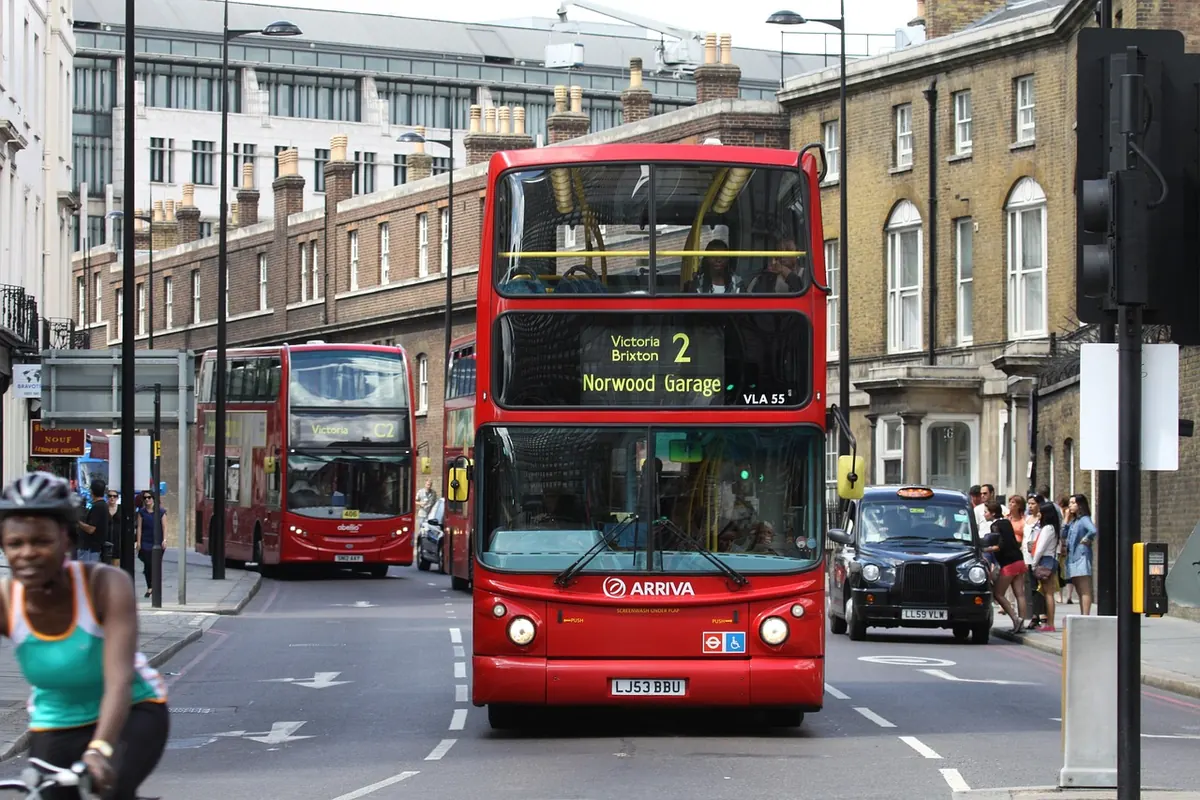
London's buses are the cheapest sightseeing in the city, and the double-deckers are the reason. Nothing else puts you level with the lions in Trafalgar Square or gives you a private view along the first-floor windows of Whitehall. The first ride can feel like a small exam, though: which stop, which door, which card, which seat. It isn't. Here is what you need before you climb the stairs.
Fares: Flat, Cash-Free and Simpler Than You Think
London buses charge a flat fare. You pay the same whether you ride two stops or to the end of the route, so there is no fare table to study and no zones to worry about. Buses are also cash-free: drivers do not sell tickets and there is no machine at the stop.
Pay by tapping a contactless bank card, a phone or watch wallet, or an Oyster card on the yellow reader beside the driver as you get on. You do not tap out when you leave. Every passenger needs their own card or device — one card cannot cover two people. Change buses within an hour and the Hopper fare means the second bus costs nothing extra, while a daily cap limits what you spend in a day. Fare amounts and cap levels change, so check the current figures on the TfL website or the TfL Go app before you travel. Children under 11 travel free on buses with a paying adult; for older children, check the current Zip card rules.
Finding the Right Stop and Reading the Route
Bus stops are not interchangeable. On a busy street you will often see three or four stops within a hundred metres, each with its own letter — A, B, C — because different routes need different places to pull in. The flag at the top of the pole lists which routes use that stop. If your route is not on the list, you are at the wrong letter.
Every stop also carries a spider map: a local diagram showing the routes nearby and where they go. It is genuinely useful and most visitors walk straight past it. On the map, check the direction of travel as well as the number. It is very easy to board the westbound bus when you want the eastbound one, especially around the one-way systems near Aldwych and Trafalgar Square.
Quick ways to plan
- Use the TfL Go app for live arrival times and a step-by-step route from A to B.
- Route numbers beginning with N run at night; some daytime routes run 24 hours.
- Note your route before you go underground. Several central Tube stations have no signal on the platforms, and you will want the map when you surface.
Boarding: What Happens at the Door
Stand where the driver can see you and put your arm out as the bus approaches. Buses stop for waiting passengers, but a clear signal saves everyone time. On most double-deckers you board at the front door and leave by the middle doors. New Routemasters, the long buses with the rounded front, have three doors and two staircases; the front door is for boarding, and the rear door is sometimes open for people getting off.
The stairs are steep, narrow and wind as they climb. Use the handrail, keep your bag close, and never stand on the stairs while the bus is moving — that is the most common way visitors hurt themselves on a London bus. Once upstairs, walk along the aisle rather than stopping at the top.
The Best Seats for Sightseeing
The front row of the upper deck is the best seat on any bus in London, and it is often empty because regular commuters want to be near the doors. Sit there and you get a driver's-eye view over the roof of the bus in front, down into squares, over garden walls and past first-floor windows.
Which side? The left-hand seats, in British traffic, always face the pavement, so they give you the close-up: shopfronts, doorways, people queuing at a bakery. The right-hand seats look across the road and often catch the bigger view — the river, a bridge, a cathedral — although this flips depending on which way the bus is heading. If a particular landmark matters to you, trace the route on the spider map and work out which side it falls on before you board.
Two seats to avoid: directly over the rear wheel arch, which is the bumpiest spot on the bus, and the back bench upstairs on a warm day, which turns into a greenhouse. If you are prone to travel sickness, sit downstairs near the middle, facing forward.
Which Route Should You Actually Ride?
Almost any central route will show you something, but the best sightseeing runs cross the river or pass through the old ceremonial heart of the city. Look for routes taking in Westminster, Whitehall, Trafalgar Square, the Strand, Fleet Street, Tower Hill, Marble Arch or Kensington. The 24, between Hampstead Heath and Pimlico, covers a lot of that ground, and several routes along the Embankment give you the Thames for a stretch. Route numbers and their paths are redrawn from time to time, so confirm yours on TfL before you set out rather than trusting an old guidebook.
Timing, Etiquette and Small Practicalities
Timing matters more than most guides admit. Weekday mornings between roughly 7.30 and 9.30, and late afternoons from about 16.30 to
Photo: scharfsascha / Pixabay